Parents and grandparents have a new financial planning opportunity to consider: the Trump Account.
The simple question is, "Should I open one for my child?" The short answer is yes – if your child qualifies for the $1,000 government contribution. The more nuanced question is whether you should contribute additional family dollars beyond that initial seed money.
As with many new pieces of legislation, there is plenty of excitement, along with a fair amount of confusion. The good news is that once you understand what these accounts were designed to do, the decision becomes much easier.
At Evermay, our view is straightforward. Take the $1,000 seed money if you are eligible. However, that doesn't necessarily mean the Trump Account is the best destination for every additional dollar you plan to save.
As Evermay Wealth Advisor Camille Svitek, CFA, CFP®, explains: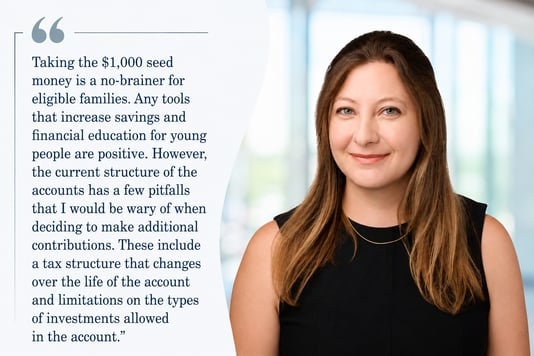
That balanced perspective is important because, like every financial planning tool, Trump Accounts have strengths and limitations.
First, Who Gets the $1,000?
Children born between January 1, 2025, and December 31, 2028, who are U.S. citizens with Social Security numbers may qualify for a one-time $1,000 federal contribution. Parents or guardians must establish the account (at https://trumpaccounts.gov/) and complete the required enrollment process.
For families with eligible children, claiming the government contribution is generally an easy decision. After all, it's difficult to argue against receiving $1,000 to jump-start decades of long-term investing.
Children born outside that eligibility window may still be able to open a Trump Account, but without the government contribution the analysis becomes more nuanced.
How Trump Accounts Work
Parents, grandparents, and others may contribute to a child's account while the child is under age 18, subject to annual contribution limits established under current law. Contributions are made with after-tax dollars and are not tax deductible.
The account is designed for long-term investing, with funds generally unavailable until age 18. At that point, it transitions into an IRA-like structure, with future distributions generally subject to the tax rules in effect at that time.
That changing tax treatment is one reason we encourage families to think carefully before making contributions beyond the initial $1,000 government seed money. Unlike a 529 plan or Roth IRA, the tax advantages evolve over the life of the account, making it important to evaluate how it fits alongside your family's broader financial plan.
Current guidance also limits investments primarily to broadly diversified, low-cost U.S. stock index funds, providing simplicity while offering less flexibility than some other investment accounts.
So, Is a Trump Account Better Than the Alternatives?
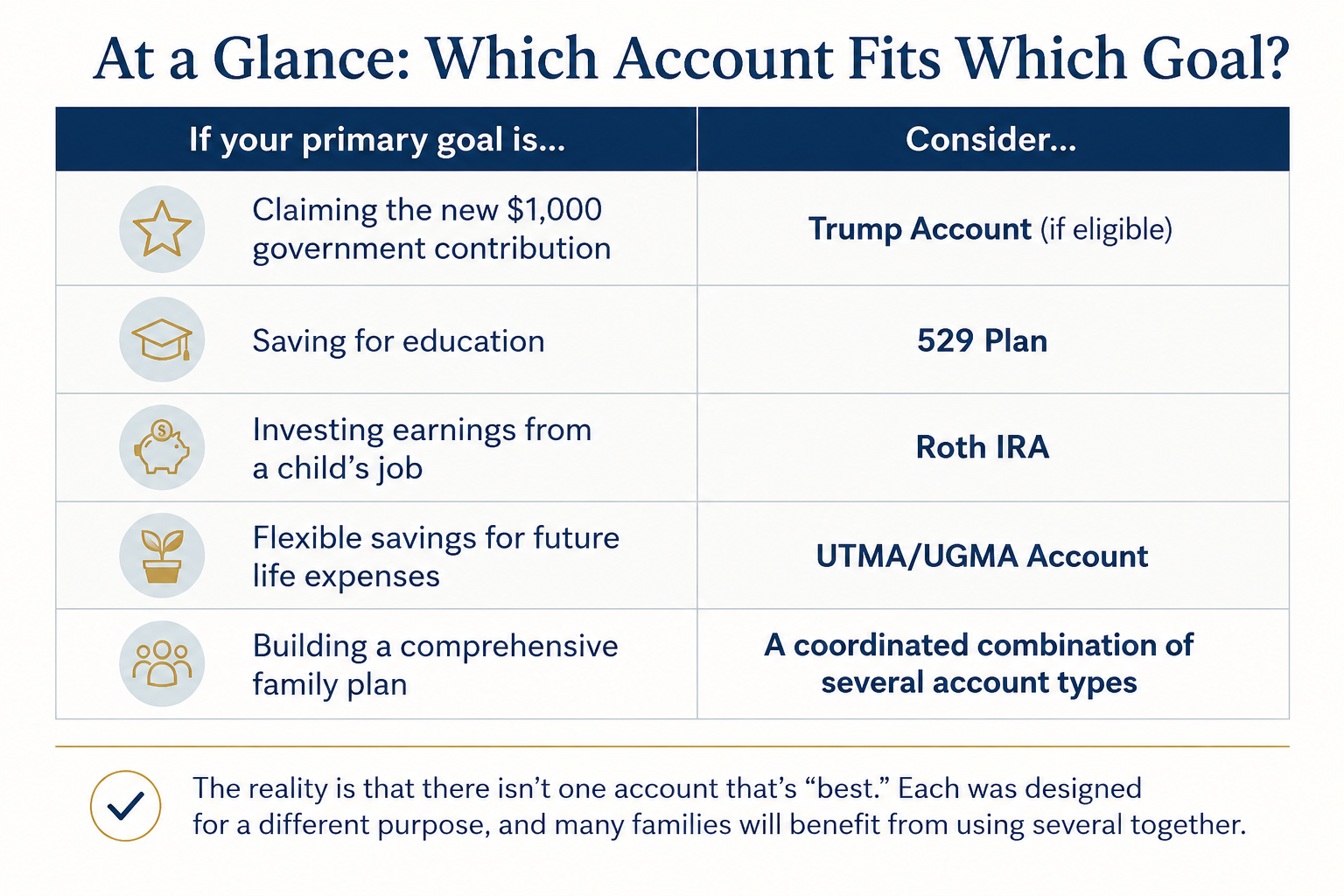
Not necessarily. Rather than replacing existing savings vehicles, a Trump Account fills a unique role alongside them.
Compared to a 529 Plan
A 529 Plan is generally the preferred choice for education savings thanks to tax-free qualified withdrawals and, in many states, additional state tax benefits. If your child qualifies for the $1,000 government contribution, the best answer may be both: open a Trump Account while continuing to prioritize your 529.
Compared to a Roth IRA
A Roth IRA is one of the most powerful long-term wealth-building tools available, but only if the child has earned income. For younger children who aren't yet working, a Trump Account allows long-term investing years before a Roth IRA becomes an option.
Compared to a Custodial Account (UTMA/UGMA)
A custodial account offers tremendous flexibility for future expenses, but may create tax considerations, affect financial aid eligibility, and eventually transfers full ownership of the assets to the child. Trump Accounts are more restrictive, but those restrictions are designed to encourage long-term investing.
Rather than asking which account is "best," the better question is which account best matches your family's goals. In many cases, the answer is a thoughtful combination of several account types.
The Long View
The greatest advantage of a Trump Account is time. A child who begins investing shortly after birth has decades for compounding to work, giving even modest contributions the potential to grow meaningfully over a lifetime while helping teach valuable lessons about long-term investing.
For families whose children qualify for the $1,000 government contribution, opening the account is generally an easy decision. The more important question is where future savings should go. That answer depends on your family's education goals, tax situation, estate planning objectives, and overall financial plan.
At Evermay, we believe the best question isn't simply, "Which account is best?" It's "Which account is best for this child, this family, and this goal?" That's the difference between selecting an account and building a thoughtful financial plan.
Have Questions? Let's Talk.
Every family's financial picture is different. The right strategy depends on your child's age, your education funding goals, retirement planning, estate planning objectives, tax considerations, and how these new accounts fit alongside your existing savings strategy.
If you'd like to discuss whether a Trump Account makes sense for your family, reach out to your Evermay Wealth Advisor. We'd be happy to help you evaluate how it fits into your overall financial plan and determine whether another savings vehicle, or a combination of several, may better serve your long-term goals.
Know Someone Who May Benefit?
If you found this article helpful, please consider sharing it with friends or family members who have children or grandchildren. These new accounts are generating plenty of questions, and a thoughtful conversation today could make a meaningful difference for decades to come.
Whether they're already working with an advisor or simply looking for objective guidance, we'd be happy to help them understand their options and build a strategy that's right for their family.
Important Disclosure Information
Evermay Wealth Management, LLC (“Evermay Wealth”) is a registered investment adviser. For more information about Evermay Wealth’s advisory services, please request a free copy of our Firm Brochure.
Past performance is no guarantee of future results. All investments involve risk, including loss of the principal amount invested. Diversification and asset allocation strategies do not ensure a profit and do not protect against a loss, especially during periods of market downturns.
This information is educational in nature, and not as a recommendation of any particular investment strategy. Given various factors, including changing market conditions, the views and opinions expressed are subject to change.
Statements herein reflect opinions regarding future financial or economic performance. Such statements are “forward-looking statements” based on various assumptions, which may not prove to be correct. Certain information contained herein was derived from third party sources as indicated. While the information presented herein is believed to be reliable, no representation or warranty is made concerning the accuracy of the information presented.
Please contact Evermay Wealth if there have been any changes to your financial situation or investment goals or if you would like to add or modify any reasonable restrictions to your investment portfolio.