December 31 may still feel a little way off, but when it comes to year-end planning, this is often the better time to start the conversation.
Some decisions take time to evaluate. Others require coordination among your tax professional, wealth advisor, attorney or other members of your financial team. And as the holidays approach, calendars fill up and the window to thoughtfully put a strategy in place can narrow quickly.
For some of you, members of our tax team have been trusted tax professionals for many years. For others, you may still be getting to know Evermay and the broader resources now available to you. Either way, we believe good planning starts with understanding the whole picture.
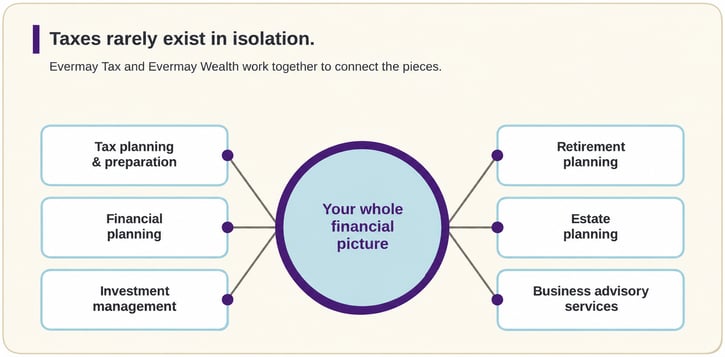
Taxes rarely exist in isolation. A decision about your investment portfolio can affect your tax return. A charitable gift can intersect with retirement distributions. A business decision can change your personal tax picture. And a family or estate-planning decision can have implications well beyond the current year.
Across Evermay Tax and Evermay Wealth, our professionals work collaboratively when appropriate to help connect those pieces — from tax planning and preparation to financial planning, investment management, retirement and estate planning, and business advisory services.
Year-end is a natural time to take stock of what has changed, what may be ahead and whether there are decisions worth considering while there is still time to act.
Here are several conversations worth having before the year comes to a close.

One of the simplest questions to ask at year-end is also one of the most important:
Is your financial picture meaningfully different than it was a year ago?
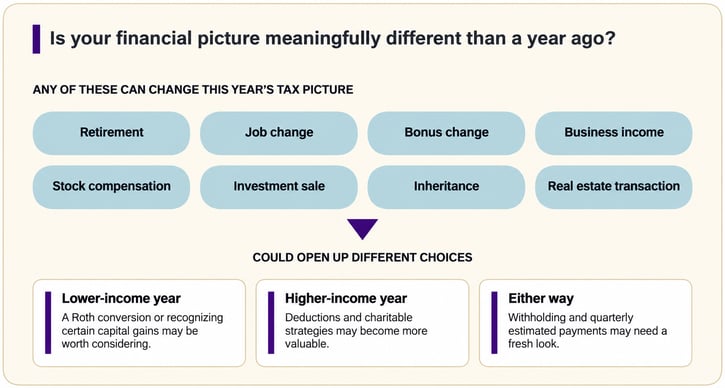
A retirement, job change, larger or smaller bonus, business income, stock compensation, investment sale, inheritance, real estate transaction or other significant event can make this year's tax picture very different from last year's.
Those changes can create planning opportunities. A lower-income year, for example, may make a Roth conversion or recognizing certain capital gains worth considering. A higher-income year may increase the value of deductions or charitable strategies. Significant changes can also affect whether your withholding or quarterly estimated tax payments remain appropriate.
Importantly, good tax planning is not always about paying the least tax in the current year. Sometimes recognizing income today, deferring a deduction or making another deliberate decision can support a better multi-year outcome.
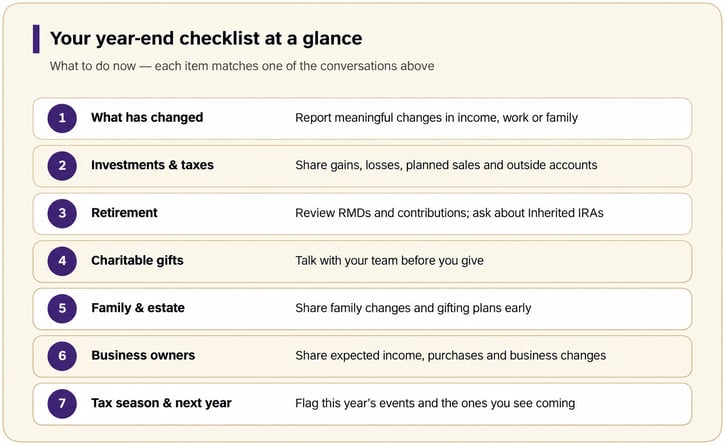
What to do now: Let your Evermay team know about any meaningful change in income, employment, investments, family circumstances or other financial activity. With time to project where you may land for the year, we can better evaluate the choices available to you.
Prior to recommending a retirement account rollover or Roth conversion, we will conduct an analysis of your retirement account and provide you with important information to help you make an informed decision.

Investment and tax planning often come together at year-end.
Market movements may create opportunities to realize investment losses to offset gains. In other circumstances, intentionally realizing gains may make sense when the tax impact is more favorable. Rebalancing, concentrated positions, cash needs and planned investment sales can all affect the conversation.
For Evermay Wealth clients, tax-aware investment management is part of our ongoing work. But even the best-coordinated team cannot plan around information it does not have — particularly activity taking place in accounts outside of our management.
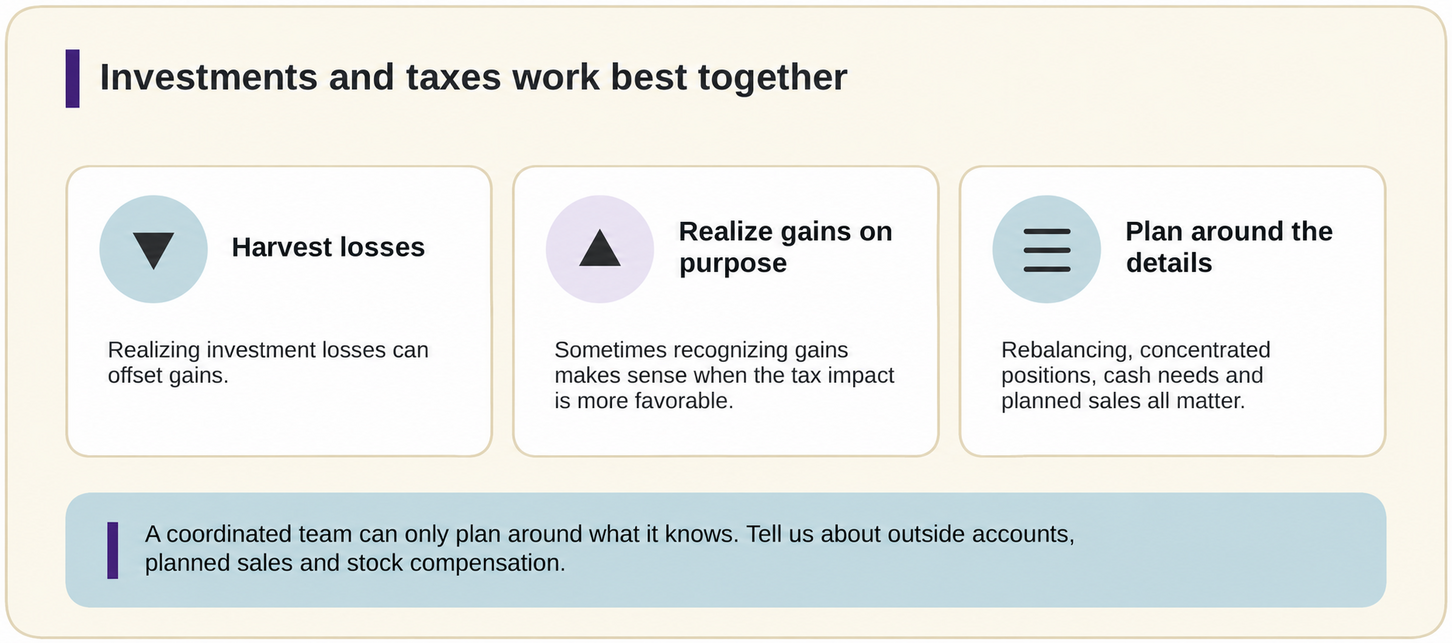
What to do now: Tell us about significant gains or losses in outside accounts, planned investment sales, stock compensation, changes in cash needs or other transactions that may affect your overall tax picture. The earlier we know, the more opportunity there is to coordinate.

Retirement accounts can create several different year-end planning considerations.
If you are subject to Required Minimum Distributions (RMDs), now is the time to confirm that the appropriate distributions are on track rather than waiting until December.
Inherited IRAs deserve particular attention. Distribution requirements can depend on when the account was inherited and the circumstances of both the original owner and beneficiary.
Year-end is also a good time to review retirement plan, IRA and Health Savings Account contributions. Changes in income or cash flow may affect how much you want to save and which accounts are most useful.
And if charitable giving is part of your plan, eligible IRA owners may want to discuss whether a Qualified Charitable Distribution, or QCD, fits into their strategy.
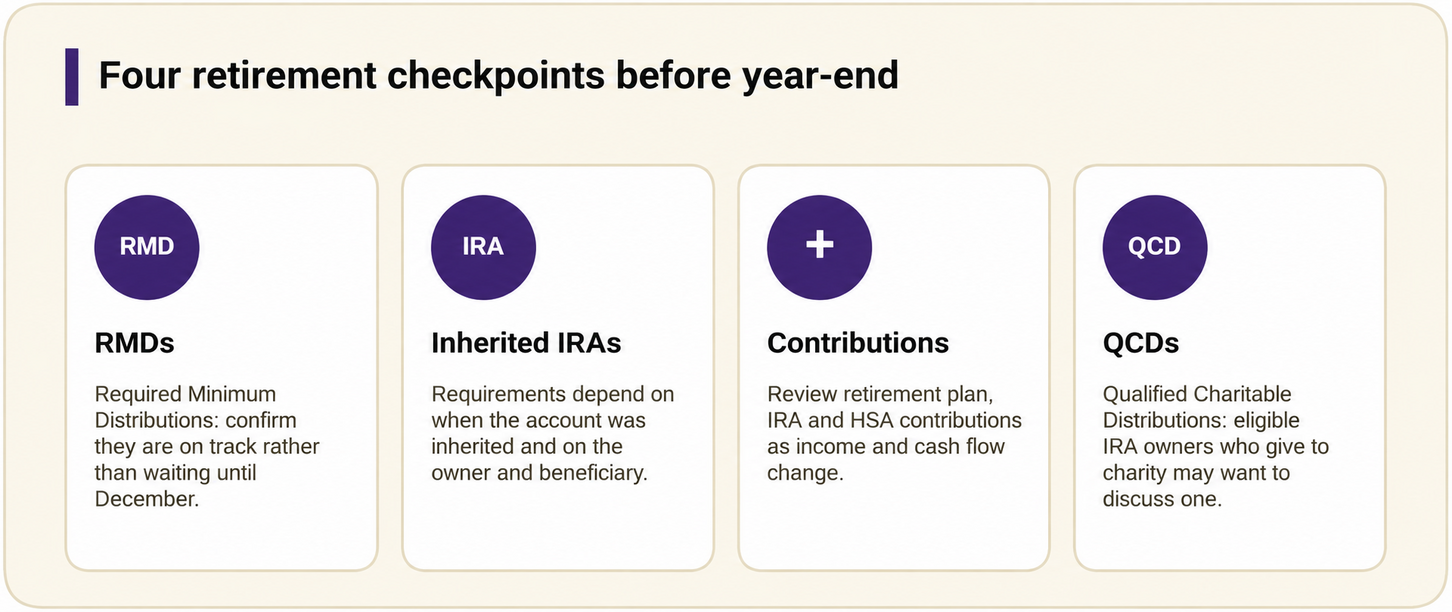
What to do now: Review required distributions and year-to-date contributions across all of your accounts. If you have an Inherited IRA or are unsure what requirements apply to you, reach out now rather than waiting until the final weeks of the year.

If charitable giving is already part of your plans, how you give can sometimes be just as important as how much you give.
Depending on your circumstances, donating appreciated investments, making a QCD or contributing to a donor-advised fund may offer advantages over simply writing a check.
Timing matters. Some opportunities may disappear once an investment has been sold or a gift has already been completed, which is why charitable planning is often best discussed before money begins to move.
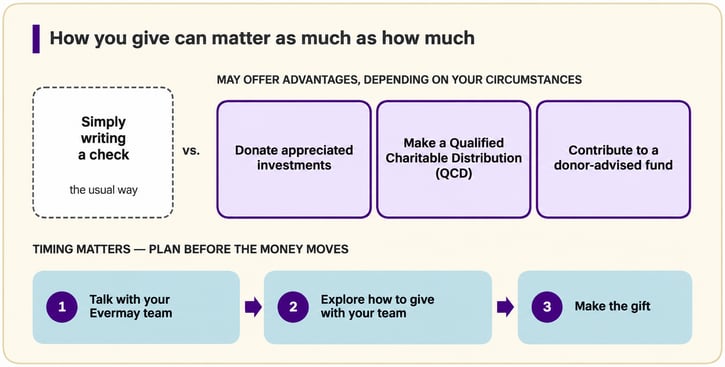
What to do now: If you are considering a meaningful year-end charitable gift, talk with your Evermay team first. There may be a more tax-efficient way to accomplish the same charitable goal.

Financial plans change because lives change.
A marriage, divorce, birth, death, inheritance or other significant family event can have implications for your taxes, financial plan and estate plan. The same is true if you are considering significant gifts to children, grandchildren or other family members.
These events may warrant reviewing beneficiary designations, account ownership, estate documents, cash-flow needs or the way assets are ultimately intended to pass to others.
Estate planning is particularly important to view alongside the rest of your financial picture rather than as a separate exercise. Your estate documents, investments, tax strategy and wishes for your family should ultimately be working toward the same goals.
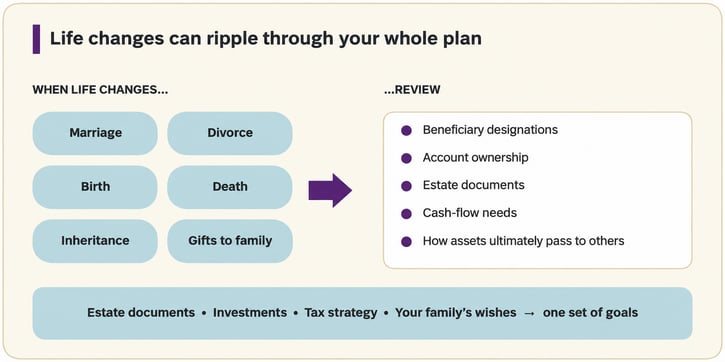
What to do now: Let us know about important family changes or gifting plans. If a tax professional, wealth advisor, attorney, estate-planning professional or account custodian needs to be involved, starting early can make the process much smoother.

For business owners, year-end planning can be especially valuable because some decisions need to be made before the books are closed.
Expected business income, retirement plan contributions, significant equipment or other purchases, the Qualified Business Income deduction, state Pass-Through Entity Tax elections and estimated tax payments are among the areas that may deserve attention.
Business decisions can also have a direct effect on an owner's personal financial picture. That is why it can be helpful to look at the business and the individual together rather than treating them as separate planning exercises.
Beyond tax preparation, Evermay's Business Advisory team can also assist business owners with areas such as financial forecasting, budgeting, accounting and operational support when a broader look at the business would be helpful.
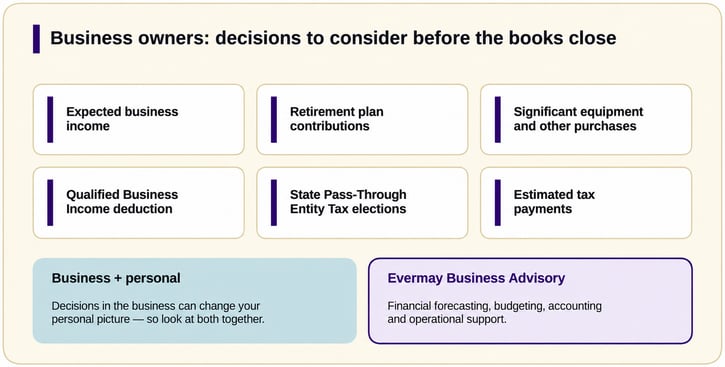
What to do now: Share your expected year-end income, significant purchases or investments you are considering, changes in your business and any major plans for the coming year. Having those conversations before the year is over gives your team more ability to evaluate your options.

Year-end planning is not only about December 31. It is also an opportunity to make the upcoming filing season smoother and begin planning for the year ahead.
Think about any significant transactions your tax team should expect to see: investment or real estate sales, new businesses or partnerships, K-1 income, stock compensation, charitable gifts, changes in residency, estimated tax payments or other unusual activity.
If you already know that next year may bring a retirement, business sale, major purchase, inheritance, liquidity event or other transition, there is value in discussing it before it happens.
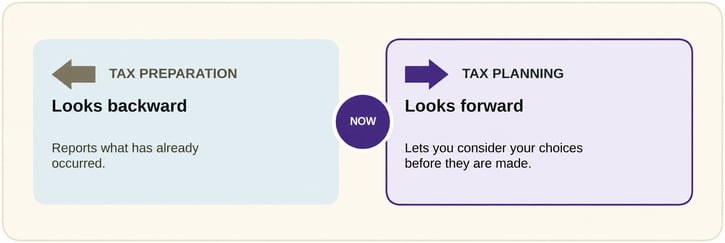
That is where tax planning differs from tax preparation. A tax return looks backward and reports what has already occurred. Planning gives you an opportunity to look forward and consider your choices before they are made.
What to do now: Make sure your Evermay team knows about both the significant events that occurred this year and the ones you already see coming next year.
The Best Place to Start Is a Conversation
Not every strategy in this article will apply to you, and there is no reason to make a financial decision simply because December 31 is approaching.
The purpose of year-end planning is to make sure the people advising you have the information they need while there is still time to be thoughtful about it.
Two questions are a good place to start:
What changed in my financial life this year?
What do I already know may change next year?
If either answer brings something to mind, let us know.
At Evermay, we believe that tax planning, investments, retirement, estate planning, business decisions and the rest of your financial life should not operate in separate silos. Our goal is to help bring the right people and information together so you can make decisions with greater clarity and confidence.
Whether you have worked with members of our team for years or are just beginning to get to know the broader Evermay organization, we look forward to continuing the conversation and helping you prepare for the year ahead.
Important Disclosure Information
Evermay Wealth Management, LLC (“Evermay Wealth”) is a registered investment adviser. For more information about Evermay Wealth’s advisory services, please request a free copy of our Firm Brochure.
Evermay Wealth Management, LLC is a registered investment adviser. Tax preparation and advice are offered through Evermay Tax, LLC. Evermay Wealth and Evermay Tax (together “Evermay”) are separate but affiliated companies and do not provide legal advice. For more detailed information about Evermay Wealth’s advisory services, including Family Office, please request a free copy of our Firm Brochure.
All investments involve risk, including loss of the principal amount invested. Diversification and asset allocation strategies do not ensure a profit and do not protect against a loss, especially during periods of market downturns.
This material is provided for informational purposes only and is not intended as individualized investment, tax or legal advice. The strategies discussed may not be appropriate for every individual or situation. Please consult with your wealth advisor, tax professional or legal counsel regarding your specific circumstances. Given various factors, including changes to tax laws or market conditions, the views and opinions expressed are subject to change.